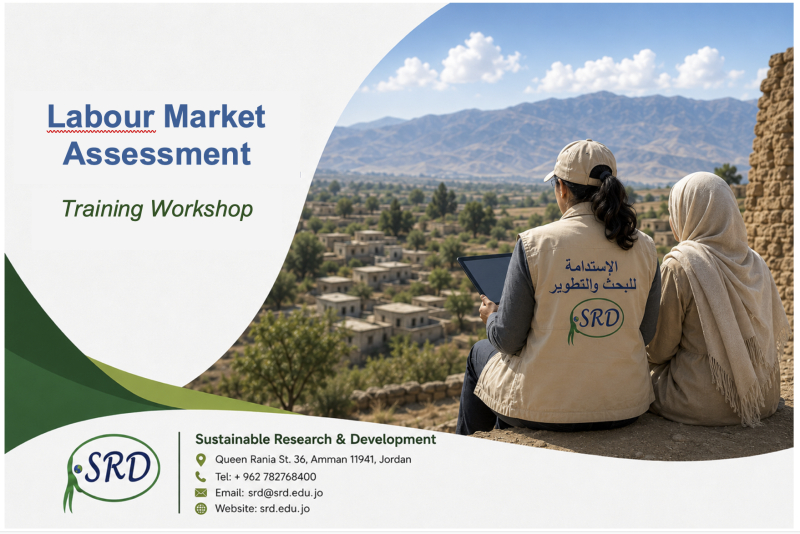
For staff supporting youth, refugees, IDPs, returnees and vulnerable communities
Duration and format: Four days
Format: Face to face
Training Overview
SRD invites staff working on programmes supporting youth, refugees, internally displaced persons (IDPs), returnees and vulnerable communities to a practical workshop on rapid, gender-sensitive labour market assessment. Participants learn to identify viable employment and livelihood opportunities and assess whether the people their programmes support can access them, including vulnerable members of host communities.
The workshop connects employer demand and local market conditions with people’s skills, experience, aspirations and barriers to work. Participants use assessment evidence to design technical and vocational education and training (TVET), job placement, self-employment and economic reintegration support. Exercises address women’s participation, disability inclusion and the different circumstances of displaced people, returnees and host communities.
Who should attend
The workshop is designed for government institutions - such as Ministries of Labour, Vocational Training Centers- NGOs, UN agencies, , community-based organizations and implementing partners that commission, conduct or use labour market assessments. Programme managers and officers; livelihoods, economic inclusion, youth-employment and reintegration teams; TVET and employment-service staff; monitoring, evaluation and research officers; and protection or community-engagement staff contributing to economic-support programmes.
What participants will be able to do
- Define assessment questions that inform employment, livelihoods and reintegration support for specific programme groups.
- Assess labour demand, existing skills and barriers such as documentation, language, transport, care responsibilities, discrimination and inaccessible workplaces.
- Design inclusive sampling and adapt interviews, surveys and focus groups to participants’ circumstances and communication needs.
- Develop and test assessment tools, including a basic KoboToolbox form, while applying consent, confidentiality and do-no-harm principles.
- Engage employers and training providers to examine entry requirements, working conditions and accessible pathways into work.
- Compare findings across relevant groups and translate evidence into training, placement, enterprise and complementary support options.
- Prepare an assessment work plan and indicators for tracking access, employment quality and livelihood outcomes.
Four day training outline
Day 1. Assessment design for inclusive programmes
Define the decisions an assessment should inform for youth, refugees, IDPs, returnees and vulnerable host communities. Review labour demand, skills supply and local market conditions. Map employers, community representatives, employment services and training providers. Select participatory methods, sampling approaches and sample sizes that include women, people with disabilities and groups less often reached by programmes. Examine how displacement history, location and access barriers affect assessment design.
Practical activity: Teams develop a methodology and scope for a programme case, defining target groups, assessment questions, sectors, locations and a sampling approach.
Day 2. Tool design and digital data collection
Adapt employer interviews, individual questionnaires, key informant guides, focus groups, household consumer-needs protocols and training-provider mapping tools. Capture prior work experience, transferable skills, qualifications, aspirations and barriers to participation. Examine language, literacy and accessibility needs. Introduce KoboToolbox and practise collecting only necessary information, explaining consent and protecting sensitive personal data.
Practical activity: Teams draft and test selected tools for employers and programme target groups, then create a short digital form. Peer review checks clarity, accessibility and sensitive questions.
Day 3. Inclusive fieldwork and employer engagement
Plan safe, accessible recruitment, interview locations and schedules. Practise interviews and focus groups without creating expectations of assistance or employment. Explore employer recruitment practices, skill requirements, pay, working conditions, apprenticeships and workplace accessibility. Identify administrative and documentation requirements for verification with competent local services. Organize daily debriefs, quality checks and referral arrangements for concerns raised during fieldwork.
Practical activity: Participants simulate an employer interview and a discussion with a programme target group, then prepare an inclusive fieldwork checklist and debrief record.
Day 4. Evidence for employment and livelihoods support
Analyse sample quantitative and qualitative data, using relevant and safe disaggregation by age, sex, disability and displacement or return status. Compare employer demand with people’s skills and access barriers. Assess wage employment and self-employment options, including demand, competition and market saturation. Compare evidence across sources and explain the assessment’s coverage limits. Translate findings into training, skills recognition, job matching, enterprise support and referrals. Prepare recommendations and indicators for access, retention, earnings and employment quality.
Practical activity: Teams present a matrix of opportunities and barriers, propose a programme response supported by evidence, and finalize an assessment work plan and report outline.
Practical learning and take-home outputs
The workshop combines case studies, short presentations, group exercises, role-play, digital practice and peer feedback. Cases address youth employment, displacement, return and host-community livelihoods. Participants develop draft tools and plans around a programme need from their own work.
- An assessment methodology with inclusive sampling and stakeholder mapping.
- Adapted assessment tools, a basic digital form and an inclusive fieldwork checklist.
- An analysis framework and matrix linking opportunities, skills and access barriers.
- A report outline and assessment work plan with programme recommendations and outcome indicators.
Delivery and participation
The programme is delivered face to face over four days. Dates and location are agreed with the commissioning organization or confirmed for each scheduled workshop. Delivery is available in Arabic or English by agreement. Content can be customized to the country, sectors, programme objectives and communities served.
Participants are encouraged to bring a laptop and an example of an assessment need from their work. Learning is reviewed through practical assignments, group presentations and facilitator feedback. Participants who complete the programme receive a certificate of participation from SRD.
Group size
Recommended group size: 15 to 25 participants.
Organizational bookings, customization and partnerships
Organizations interested in purchasing or customizing this programme should submit an enquiry outlining their requirements. Fees for organizational bookings and customized programmes are provided upon request and depend on delivery location, duration, language, customization, venue arrangements, travel, participant numbers and the number of workshops requested.
Organizations seeking to become authorized SRD partners to market and deliver this programme should submit a brief organizational profile, relevant training experience and proposed areas of cooperation. Suitable applicants will be invited to an introductory meeting to discuss the cooperation model, responsibilities, commercial arrangements, quality standards and next steps toward signing a partnership agreement.
Fees:
The standard course fee is USD 1,200 per participant for the full four-day programme. The fee includes instructor-led training, training materials, practical exercises, a certificate of participation, and the trainer’s travel and accommodation costs. It excludes the training venue, participants’ travel and accommodation, meals, visa fees, and participants’ internet or equipment costs.
Related materials:
تقييم سوق العمل، خطوة بخطوة Labour Market Assessment, Step by Step