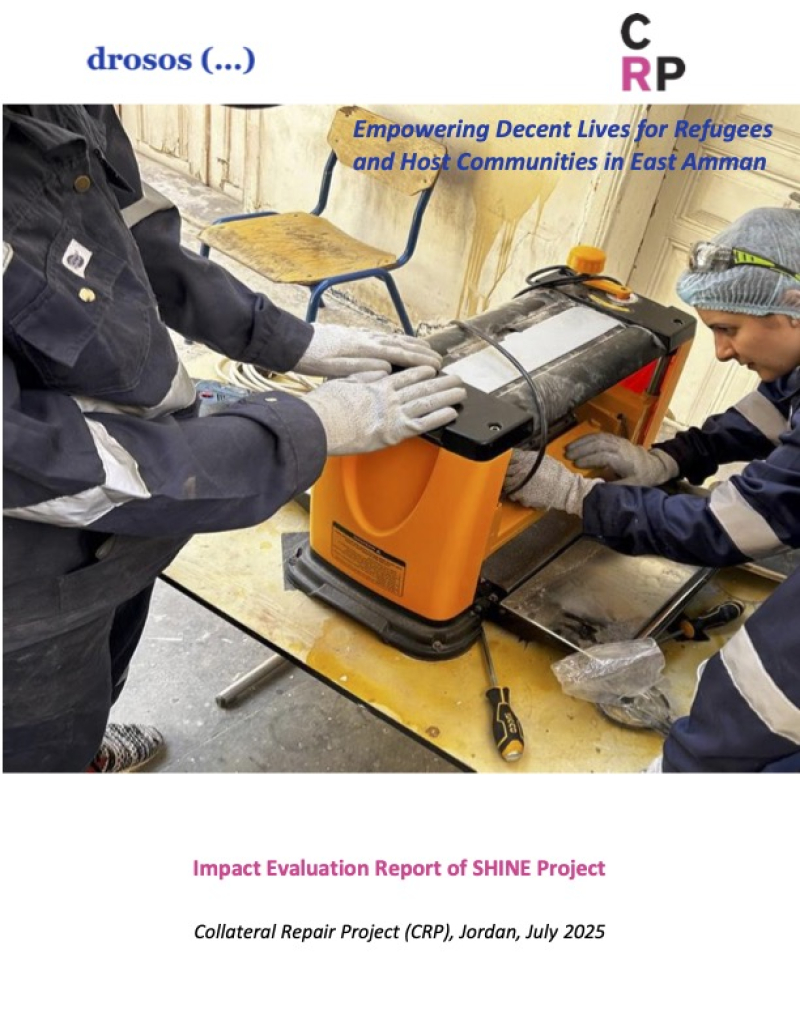
Empowering Decent Lives for Refugees and Host Communities in East Amman
Impact Evaluation Report of SHINE Project
Collateral Repair Project (CRP), Jordan, July 2025
Impact Evaluation of ““Enhancing livelihood opportunities and improving housing conditions for vulnerable refugees and Jordanians in East Amman, Jordan - SHINE Project,”
© Collateral Repair Project (CRP)
Amman, Jordan
July 2025
Executive Summary
Within the framework of the strategic objective of the Collateral Repair Project (CRP) in Jordan to ensure that refugees and host populations living in host communities access their rights, are safe and self-reliant, and refugees are able to avail themselves of a durable solution, a development cooperation project, “Enhancing livelihood opportunities and improving housing conditions for vulnerable refugees and Jordanians in East Amman, Jordan - SHINE Project,” is being implemented. It started in January 2023 and will continue through December 2025. The main objective of the 3-year project, funded by the Drosos Foundation, is to enhance livelihood opportunities and improve housing conditions for vulnerable refugees and Jordanians in East Amman, Jordan. The project provided vocational and soft skills training to refugees and disadvantaged Jordanians residing in two underprivileged areas of East Amman (Hashemi Shamali and downtown). The goal of these trainings is to equip beneficiaries with technical skills with an emphasis on business, upcycling, home maintenance, and soft skills. As part of the monitoring and evaluation plan of the SHINE project, CRP has commissioned an independent external consultant to carry out this impact evaluation. Therefore, the purpose of this impact evaluation is to assess the overall achievements of the project against its planned outcomes to generate lessons learned, best practices, and recommendations.
The evaluation methodology adopted a mixed method approach, triangulating quantitative and qualitative data collection activities. Data has been collected from the beneficiaries using in-person interviews, phone calls, and focus group discussions (FGDs), while the semi-structured interviews were conducted in person with the project team, trainers, and team leaders. The project team has facilitated the planning of the data collection activities; however, the evaluation team has conducted the data collection and analysis independently. As of June 2025, the project contributed to supporting 217 beneficiaries (78 participants in home maintenance training, 62 in upcycling training, and 77 beneficiaries whose living and housing conditions improved). Out of the 217 beneficiaries, this impact evaluation reached 91 beneficiaries (34 participants in home maintenance training, 36 participants in upcycling training, and 21 beneficiaries whose living and housing conditions improved) and 5 staff from the project team. The evaluation reached 41.9% (56% female, 44% male) of the project population.
Based on the desk review of the project related documents, the project has achieved significant progress toward its main goal of increasing self-reliance and fully using and applying the learned skills in the beneficiaries’ daily lives. The project had already achieved 86.67% (as of June 2025) of its target for vocational skill acquisition, suggesting significant progress toward complete completion by the project's conclusion date in December 2025. These findings indicate that the project is on course to meet, and in some cases exceed, its objectives and outputs through the effective execution of vocational and business skills training.
The project has made strong progress toward its goal of training 90 participants in home maintenance skills by December 2025, with 78 individuals already trained. It has also surpassed its targets for improving participants skills, including vocational, soft, and business skills (71.43% vs. a 70% target) and enhancing participants' ability to generate income (64% vs. a 50% target), demonstrating the effectiveness of its vocational and business training courses. However, challenges such as high demand, difficulty reaching certain refugee groups, and legal work restrictions have limited the extent to which some beneficiaries can fully apply the learned skills in their daily lives, highlighting the need for more inclusive and enabling support mechanisms.
The project demonstrated strong relevance by directly addressing the needs of its target population through a context-driven, community-informed design. Drawing on lessons from previous initiatives and leveraging the firsthand knowledge of CRP staff, many of whom are residents or community leaders, the project was closely aligned with local priorities. Its activities were shaped by direct feedback from beneficiaries, ensuring responsiveness to actual needs. The choice of implementing the project in East Amman's most underserved areas (Hashmi Shamali and Downtown) further reinforced its relevance, as these neighborhoods host large numbers of vulnerable refugees and low-income Jordanians. Additionally, the project's active engagement with local and international stakeholders across key service sectors enabled a robust referral network through the CRP Help Desk, ensuring beneficiaries had access to health, legal, and social support. This strategic integration of community insights, geographic targeting, and stakeholder collaboration made the project highly relevant and well-suited to the realities of the target population.
The project had a clear and positive impact on both individual trainees and the wider community by equipping participants with practical skills in upcycling and home maintenance, as well as soft and business skills, enabling beneficiaries to produce marketable goods, support their families, and serve vulnerable households in East Amman. Some beneficiaries have already begun earning income through the nonformal sector or small works for neighbors and relatives. Many beneficiaries expressed newfound confidence and a shift in mindset toward environmental sustainability and resource efficiency. Despite this accomplishment, a number of institutional and logistical constraints, such as a lack of access to work tools and materials, workspace, and legal work permits, have hindered participants’ ability to fully use and implement their newly acquired skills in their daily lives. This emphasizes the importance of combining vocational training with enabling support mechanisms, such as access to equipment and legal facilitation, to fully realize the long-term impact and potential of such a project.
The project demonstrates strong sustainability through its focus on practical, long-lasting skills that beneficiaries continue to use beyond the training period. Participants reported applying the learned knowledge and skills in daily life, such as in fixing electrical and plumbing issues, painting, and addressing home maintenance needs, which confirms the financial benefits of the training. The upcycling component, in particular, stands out as highly sustainable due to its use of low cost, upcycled materials and the establishment of fully equipped workshops that can be maintained and expanded after the project ends. The integration of vocational skills with social goals, such as community engagement and gender inclusion, further strengthens the project's long-term sustainability. Additionally, the enthusiasm of beneficiaries to continue learning and producing upcycled items, even without incentives, highlights the project’s potential for ongoing impact, skill development, and market responsiveness. Together, these elements reflect a well-integrated, enduring model that fosters self-reliance and community resilience.
The evaluation presented several recommendations to enhance the effectiveness, inclusiveness, and sustainability of the project. These include improving the selection of competent and culturally sensitive trainers, with an emphasis on female trainers where appropriate, to create a safe and supportive learning environment. It also recommends strengthening partnerships with legal aid organizations to offer accurate information and support for refugees seeking work permits and engaging in multi-stakeholder advocacy efforts to address systemic barriers to legal employment. To improve the quality of vocational training, the report advises developing a comprehensive individual planning tool to track and guide trainee skill development during and after the training course. Furthermore, CRP is encouraged to formalize a stakeholder coordination strategy to deepen collaboration with private sector actors and online platforms, supporting participants’ transition into employment or entrepreneurship. Reaching hard-to-reach refugee groups through trusted networks and mobile outreach is also highlighted as essential to ensuring the inclusivity and equity of the project, as well as the report emphasizes the importance of disability inclusion, urging CRP to adopt a comprehensive strategy involving accessibility improvements, staff training, inclusive program design, and strong referral mechanisms for individuals with protection needs. Finally, to strengthen the long-term impact, the evaluation suggests expanding access to basic toolkits and workspaces for upcycling graduates, enhancing post-training follow-up mechanisms for mentorship and advanced training, and adding garment upcycling and plumbing repairs to the curriculum to diversify vocational training opportunities.
Doownload full report